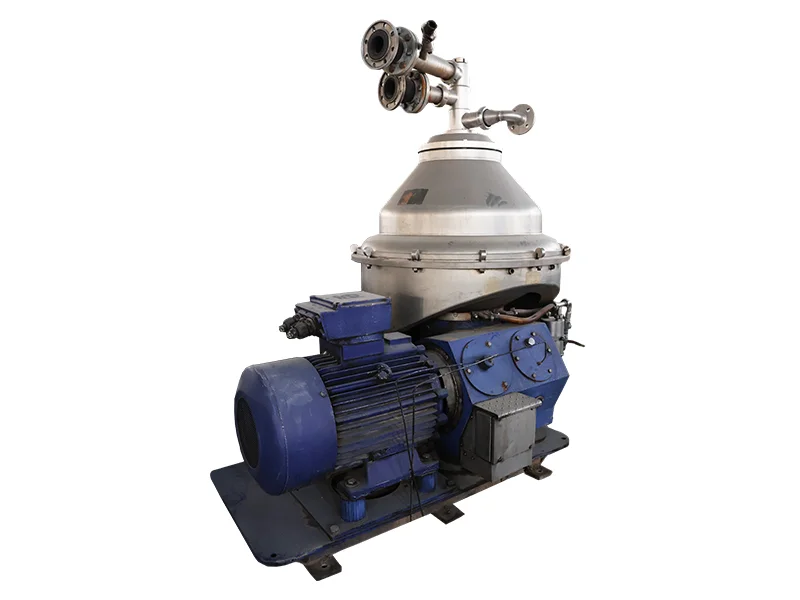
”Equipment Status Check”: Inspect that frame fixing bolts are tight; ensure the drum and disc stack run smoothly without jamming (turn manually 1–2 rotations to confirm free rotation and no abnormal noise). Check seals, oil lines, and water connections for no leakage.
”Oil & Lubrication Check”: Verify gearbox oil level is between the upper and lower limits of the oil gauge, with no cloudiness or emulsification. Ensure sufficient oil in the automatic lubrication reservoir (recommended ≥ 2/3 full) and unobstructed lubrication lines.
”Auxiliary System Preparation”: Start the cooling water system and adjust flow to ”10–15 L/min”to match drum cooling requirements. Confirm feed pump, sludge discharge pump, and flushing pump are normal; pipeline valves are in correct initial position (feed and discharge valves closed, flush and return valves open).
”Electrical & Control System Check”: Confirm stable power supply (380V/50Hz) and no fault alarms on the PLC. Check motor rotation direction: if stopped for over 1 week, jog the motor to confirm rotation matches the label (clockwise, viewed from the motor end).
”Material Pre-Treatment Confirmation”: Feed temperature controlled at ”60–90°C”(suitable for cooled drum); no large impurities (particle size ≤5mm); feed pressure stable at ”0.1–0.2 MPa”.
(II) Start‑Up Procedure
Activate the control system, enter standby interface, and confirm the “Equipment Ready” indicator is lit.
Start the automatic lubrication system, set lubrication interval (once every 300 hours, 9g per end per cycle), and confirm lubrication pump operation.
Start the main motor; the machine enters acceleration phase. Monitor the speed ramp closely (normal acceleration: 2–3 minutes, final stable speed: ”4136 rpm”). Also observe vibration (≤4.5 mm/s) and bearing temperature (≤75°C).
After reaching full speed, perform pre‑feed water filling: inject clean water into the drum via the liquid seal valve until steady flow appears at the drain to form a complete liquid seal and reduce oil leakage during discharge. Filling time: approx. 1–2 minutes.
Slowly open the feed valve and close the return valve; adjust feed rate to initial value (recommended ”8–10 m³/h”, low‑load start). Observe stable flow at oil and water outlets with no impurity entrainment.
(III) Normal Operation Monitoring
”Key Parameter Monitoring”: Record drum speed (stable at 4136 rpm), motor current (≤70A for 37kW), bearing temperature (≤75°C), and vibration (≤4.5 mm/s) every 15 minutes. Check oil‑in‑water (≤10 ppm) and water‑in‑oil (≤0.1%) every 30 minutes.
”Auxiliary System Monitoring”: Maintain continuous cooling water supply with stable flow. Ensure automatic lubrication operates per set schedule and reservoir level is normal.
”Abnormality Handling”: In case of excessive vibration, sudden temperature rise, leakage, or other faults, immediately open the return valve, close the feed valve, reduce speed to stop, and troubleshoot before restarting.
(IV) Normal Shutdown Procedure
Slowly close the feed valve, open the return valve, and stop the feed pump.
Keep the main motor running, start the flushing pump, and inject clean water (or special cleaning agent) into the drum for approx. ”5–10 minutes”until discharged liquid is free of oil and impurities.
Stop the flushing pump and close the flush valve. Activate the sludge discharge cycle and perform ”1–2 manual discharges”to remove residual solids.
Run the main motor deceleration program for slow speed reduction (no emergency stop; deceleration time ≥3 minutes) until the drum stops completely.
Shut down cooling water and automatic lubrication systems; disconnect main power. Clean the machine surface, check seals at all connections, and complete operation records.
(V) Emergency Shutdown
Press the emergency stop button immediately if: severe vibration, bearing overheating (≥90°C), serious leakage, motor failure, etc.
The system automatically cuts main motor power; the drum coasts to a stop (forced braking is prohibited).
After shutdown, close feed and cooling water valves, identify the cause. Do not restart until the fault is resolved.